

 زوايا ميادين | Mayadin Columns صوت من لا صوت له | الإعلام البديل
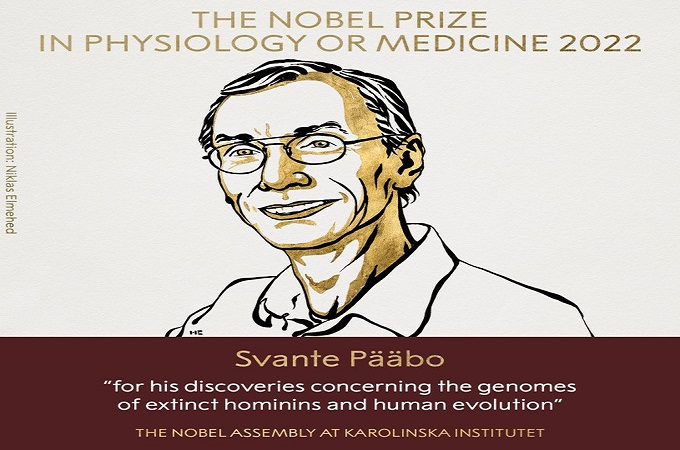
The Nobel Prize in Physiology or Medicine has gone to Sweden’s Svante Paabo for his work on human evolution.
Today the 2022 #NobelPrize in Physiology or Medicine was awarded to Svante Pääbo. Take a look at all of today's news:https://t.co/GleXwQOxne
— The Nobel Prize (@NobelPrize) October 3, 2022
The Prize committee said he achieved the seemingly impossible task of cracking the genetic code of one of our extinct relatives – Neanderthals.
— The Nobel Prize (@NobelPrize) October 3, 2022
He also performed the “sensational” feat of discovering the previously unknown relative – Denisovans.
His work helped explore our own evolutionary history and how humans spread around the planet.
Watch the very moment the 2022 Nobel Prize in Physiology or Medicine is announced. Presented by Thomas Perlmann, Secretary-General of the Nobel Assembly.
— The Nobel Prize (@NobelPrize) October 3, 2022
See the full announcement: https://t.co/fcLxEf9p0W #NobelPrize pic.twitter.com/Q4emKNZ2Mo
The Swedish geneticist’s work gets to the heart of some of the most fundamental questions – where do we come from and what allowed us, Homo sapiens, to succeed while our relatives went extinct.
He was just off to pick his daughter up from a sleepover when he got the call saying he’d won. He told the BBC: “I was very surprised and overwhelmed, I had not expected this.”
In the 1990s, research on working out the human genetic code was taking place at pace. But that relied on fresh samples of pristine DNA.
Prof Paabo’s interest was in the old, degraded and contaminated genetic material from our ancestors. Many thought it was an impossible challenge. But he was, for the first time, able to sequence DNA from a 40,000-year-old piece of bone.
2022 #NobelPrize laureate in physiology or medicine Svante Pääbo was born in 1955 in Stockholm, Sweden.
— The Nobel Prize (@NobelPrize) October 3, 2022
In 1999 he founded the Max Planck Institute for Evolutionary Anthropology in Leipzig, Germany (@MPI_EVA_Leipzig) where he is still active.https://t.co/w31ccQ5218 pic.twitter.com/SQveQE3AZL
Those results showed that Neanderthals – who mostly lived in Europe and Western Asia – were distinct from both modern day humans and chimpanzees.
His work focused on hominins – the group of modern humans that includes us, Homo sapiens, but also our extinct relatives.
“By revealing genetic differences that distinguish all living humans from extinct hominins, his discoveries provide the basis for exploring what makes us uniquely human”, the Nobel committee said.
Further comparisons between Neanderthal DNA and humans from around the world showed their DNA was a closer match to humans coming from Europe or Asia.
This tells us that Homo sapiens had sex and children with Neanderthals after migrating out of Africa around 70,000 years ago.
And you can still see the legacy of that today. Between 1-4% of modern human DNA comes from our Neanderthal relatives and this even affects our body’s ability to respond to infection.
World Opinions + BBC News